Showing posts with label Healthcare. Show all posts

Monday, April 20, 2020

Health Insurance In the Time of COVID-19

U.S. Census Bureau releases new 2018 Small Area Health Insurance Estimates

By Lecia Parks Langston, Senior Economist
 
“Americans want jobs. They want affordable health insurance. They want an education.” John McCain
 
 
As the world hunkers down under the effects of a pandemic, the need for health insurance coverage becomes even more apparent than usual. Just how many Utahns are covered by health insurance? Who are the uninsured? Data just released by the U.S. Census Bureau (2018 Small Area Health Insurance Estimates (SAHIE)) provides enlightenment on healthcare coverage in the under-65-year-old population. Additional demographic information is available from the American Community Survey, rounding out our understanding of the insured and uninsured in Utah.
 

Small Area Estimates

The SAHIE estimates cover the population under 65 years of age. Of course, virtually all citizens 65 and older are covered by government-provided Medicare benefits. Because these estimates date back to 2008, two years before the signing of the Affordable Care Act (ACA), they suggest the how the ACA has changed the health-insurance landscape in Utah.
 
 
Compared to other counties across the United States, Utah’s counties, for the most part, had mid-level to high levels of insured individuals in 2018 (the most recent data available). National regions of high coverage include northern eastern states and the west coast. Texas seems to have the highest uninsured levels with a vast number of counties experiencing uninsured rates of greater than 20%. Most Utah counties have uninsured shares below 15%.
 
In 2018, Morgan, Davis, Daggett and Emery counties showed the highest insured rates in Utah. In contrast, San Juan, Duchesne, Uintah, Piute and Garfield experienced the lowest rates of health insurance coverage.


That was then, this is now

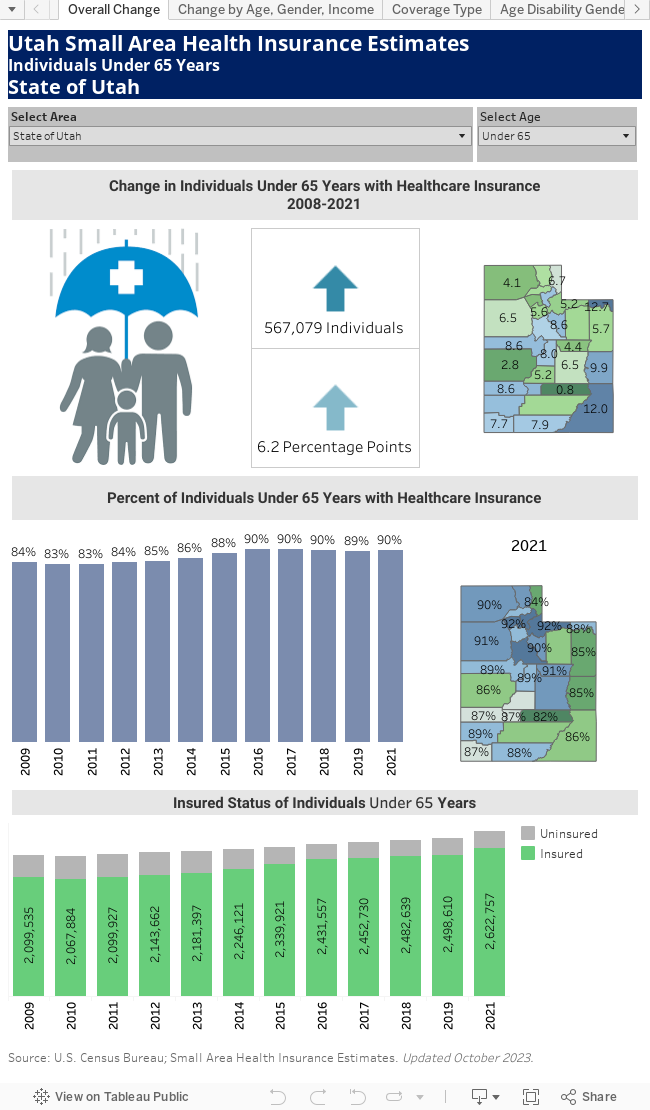
The number and share of Utahns covered by health insurance have certainly improved in the past 10 years. In 2008, roughly 83.7% of the under-65 population was insured compared to about 89.6% in 2018, an increase of nearly 6 percentage points. In terms of individuals, that increase represents a gain of 427,000 insured Utahns.
 
However, coverage appears to have peaked in 2016 at 90.3% and has since retrenched. The repeal of ACA’s individual mandate and price increases, due to the elimination of cost-sharing reductions to payers selling individual plans, likely contributed to the recent slight decline in Utah coverage. However, the state’s Medicaid expansion, effective in 2020, should help bump up insured rates.

Less-populated counties, with initial low insured rates, experienced the strongest gains in insured shares. Daggett, Rich, Grand, Kane and San Juan counties displayed gains of roughly 10-points or higher. While all counties showed an improvement in the insured share of the under-65-year population, Salt Lake, Carbon, Summit and Millard counties experienced the smallest gains.
 

Highlights from the American Community Survey (2014-2018)

  • Roughly 58% of Utahns (of all ages) are insured in full or in part by employer-provided plans. Only 9% directly purchase their entire insurance coverage from a private provider. In total, nearly 70% of the state’s citizens have private coverage.
  • In total, public plans (Medicare and Medicaid) cover roughly 12% of Utah’s population. About 7% of the population is covered by Medicaid with another 3% covered by just Medicare. Roughly 1% of Utahns have coverage under both Medicare and Medicaid.
  • Those with a combination of public and private coverage account for another 9% of Utah’s population. That group includes 4% of Utahns who carry Medicare plus a supplemental source of private insurance. On the other hand, 10% have no healthcare insurance at all.
  • The very young and the very old are most likely to carry health insurance. Thanks to Medicare, individuals 65 years and older are the most likely to be covered (99%). On the other end of the spectrum, children under 6 years old displayed a coverage rate of 94%, with 6-18 year olds not far behind (92%).
  • Individuals between the ages of 26 and 34 are the least likely to have health insurance. Only 84% are covered in Utah.
  • By gender, females (91%) are just slightly more likely than males (89%) to maintain health insurance. This may be partially due to the dominance of women in the highly-covered 65-years-and-older group.
  • Education shows a high correlation with health insurance coverage. Persons with a bachelor’s degree or higher show the highest coverage rate — 96%. On the other end of the scale, individuals who did not graduate from high school maintained an insured rate of just 68%.
  • Not surprisingly, of all labor force statuses, the unemployed are least likely to have health insurance (65%). Interestingly, those not in the labor force (which would include the retired), display an insured rate just slightly lower than the employed. In addition, based on work experience, individuals working full-time, year-round are the most likely group be insured.
  • Household income is also a good predictor of health insurance coverage. Those with the highest incomes ($100,000 and over) have the highest coverage rates (95%). In contrast, those with the lowest incomes (under $25,000) have the lowest coverage rates (81%). a
  • Latino and Native Americans show the lowest rates of any major ethnic/racial groups. Rates for both sets measure just 73%. White, non-Latino Utahns maintain the highest health insurance coverage shares.
  • Only 56% of noncitizens have health insurance in Utah compared to 92 percent of Utahns born in the United States.

Monday, October 14, 2019

Intermountain Healthcare considers 5-year plan for proposed hospital in Hurricane

Dixie Regional Medical Center has announced intentions to build a new hospital in Hurricane, providing the growing community with much-needed emergency services. DRMC administrators will know whether their proposal has been approved by Intermountain Healthcare’s capital committee by the end of this month. If their plans are approved, the hospital will be built as an add-on to the Hurricane Valley Clinic, where the hospital already owns 28 acres of land. St. George News

Tuesday, January 29, 2019

Kane County Hospital set to begin $15 million expansion

Expansion plans are underway for the Kane County Hospital. Renovations will include an expanded emergency room with patient waiting rooms, improved security and expanded pharmacy. There will also be an expanded operating room recovery area, as well as an expanded day and dining room in the long-term care facility. The hospital will not be increasing patient beds since it was determined the number was already adequate. The total project will cost $15,000,000. The hospital has set aside $5,000,000 from the one percent rural hospital sales tax toward the project, and has a CIB loan for the remaining $10,000,000. Southern Utah News

Wednesday, September 26, 2018

Kane County Hospital planning on $10 million expansion and remodel

Kane County hospital is planning an expansion and remodel. It has received a $10M bond through the Community Impact Board. This bond will be repaid using the 1 percent Rural Hospital Sales Tax revenues received through the county every year. Southern Utah News

Monday, March 5, 2018

Construction is on schedule for Dixie Regional Medical Center’s project

Construction is on schedule for Dixie Regional Medical Center’s $300 million expansion/consolidation project that will merge the two hospital campuses in St. George. Four separate buildings have been under construction beginning in April of 2016 and have staggered completion dates this year.

All will be celebrated in a grand opening scheduled for Wednesday, Sept. 12. The Intermountain Precision Health Center and Women and Newborn Center will be completed in October. The northeast tower will open in June, and the smallest addition -- the diagnostic and treatment center - will open next month. This new hospital addition houses 50-plus flex beds, all clinical lab services, and two new high-tech surgical suites. The Spectrum

Thursday, April 27, 2017

Health Insurance: Who’s covered in Utah?

Census Bureau Estimates Provide Answers about Utah Health Insurance Coverage


By Lecia Parks Langston, Senior Economist

“Most Americans want health insurance.” Jacob Lew

The U.S. Census Bureau just published its Small Area Health Insurance Estimates (SAHIE) for counties and states while the national discussion on health care laws receives renewed attention. Is this a coincidence? Yes, but a timely one. This post examines how health insurance coverage for Utahns has changed and also the demographics of who has coverage and who does not.

Tracking Utahns Under 65 Years of Age

Small Area Health Insurance Estimates cover the population under 65 years of age. Of course, virtually all residents 65 and older are covered by government-provided Medicare. Because the estimates date back to 2008, two years before the signing of the Affordable Care Act (ACA), the available figures provide an indication of the effect of the ACA on health insurance coverage in Utah and its counties.
More Utahns have Health Insurance

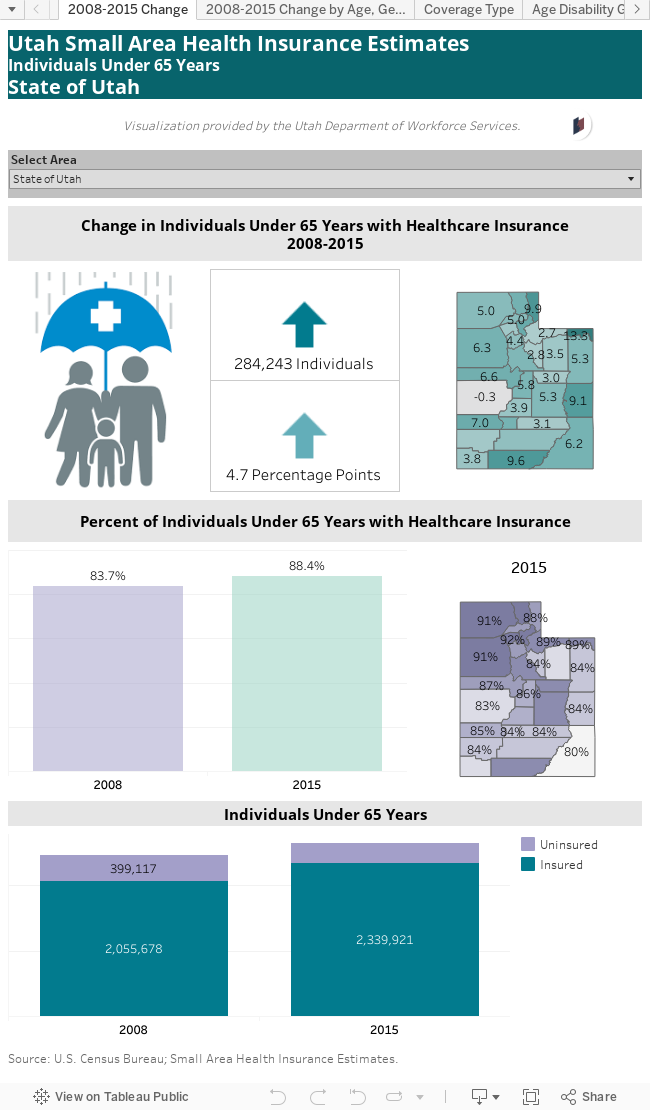
Between 2008 and 2015, the number of Utahns under 65 years old covered by health insurance increased by 284,000. Not only did the actual covered increase, but the share of non-senior population with health insurance also gained ground expanding from less than 84 percent to more than 88 percent — an increase of 4.7 percentage points.

Only Millard County experienced a very slight 0.3 percentage point decline in health insurance coverage although the actual number of persons covered increased by 113. Daggett, Rich, Kane and Grand counties showed the highest growth in under-65 coverage; each showed increases of at least 9 percentage points.

In 2015, counties in northern Utah generally showed the highest level of non-senior health insurance coverage. In Morgan, Davis, Box Elder, Tooele and Cache counties, health insurance rates top 90 percent. On the other end of the scale, rural counties in central and southern Utah display the lowest coverage. In San Juan, Millard, Duchesne and Wayne counties, health insurance rates for those under 65 measured 83 percent or less.

Those under 19 saw the greatest gains. Coverage rates for these young people increased from 87 percent in 2008 to 93 percent in 2015. Utah males experienced a larger gain in coverage between 2008 and 2015 (5 percentage points) than did females (4 percentage points), although females were more likely than men to carry health insurance in both years. Health insurance rates for those with the lowest incomes showed the most improvement (10.4 percentage points). However, their coverage shares remain roughly 10 points below average.

Wait, There’s More…

Wednesday, March 15, 2017

Rocky Vista University in Ivins nears completion

Rocky Vista University’s for-profit osteopathic school on the southeast edge of the Denver metropolitan area announced plans to add a second campus in Ivins in October 2015 and began grading its 30-acre parcel at the intersection of Center Street and 200 East last March.

Shaw Construction expects to place facades within the next month on buildings that, for now, look more like burlap and boards, with plans to complete work by mid-June on the 104,000-square-foot school and office facility plus two on-campus residential apartment complexes. A third student apartment building will be completed a couple months afterward, with reserved plans for two more once they are needed.

A ribbon-cutting ceremony is planned July 14 followed by a public open house July 15, then student orientation on July 17 and the start of classes July 25 after the Pioneer Day holiday. The Spectrum

Friday, June 24, 2016

Dixie Regional Medical Center breaks ground on ambitious expansion

The official groundbreaking was recently held for Dixie Regional Medical Center’s latest building project, a 406,000 square-foot expansion project.

The expansion features a four-level tower west of the existing hospital’s Emergency Room entrance, which will support labor and delivery services, the Neonatal Intensive Care Unit and postpartum care, as well as imaging clinics and space for behavioral health patients.

On the southeast side of the hospital, by 700 South / Foremaster Drive, another four-story tower will provide space for adult Intensive Care Unit patients, wound care as well as pediatric and neurological patient beds. An addition on the hospital’s northeast side will provide new space for care related to the Emergency Room and the Operating Room. Altogether, the expansion doubles the size of DRMC’s facilities and will provide the campus with more than a million square feet of building space.

The expansion will also include about 50,000 square feet of renovation and about 117,000 square feet of new building space for Southern Utah’s burgeoning cancer research and treatment efforts — a three-story structure that will be situated northeast of the main hospital building between it and Dixie State University’s Taylor Health Science facility. The Spectrum

Wednesday, May 18, 2016

Health insurance coverage improving in Southwest Utah

The Census Bureau Releases 2014 Small Area Health Insurance Estimates 


By Lecia Parks Langston, Senior Economist 

“Poverty and no health insurance coverage keeps the doctor away — apples have nothing to do with it.” Beryl Dov 

The goals of the Affordable Care Act (ACA) include expanded health insurance coverage in the United States. Most of the Act’s health insurance expansion provisions went into effect January 1, 2014. The U.S. Census Bureau’s recently-released 2014 Small Area Health Insurance Estimates  provide an initial glimpse of the early outcomes of ACA on health insurance coverage. Keep in mind that health insurance coverage runs the gamut from employer-provided plans to personal insurance to government Medicaid and Medicare coverage. These estimates cover individuals under the age of 65, since those 65 and older are eligible for government-provided health insurance through Medicare.

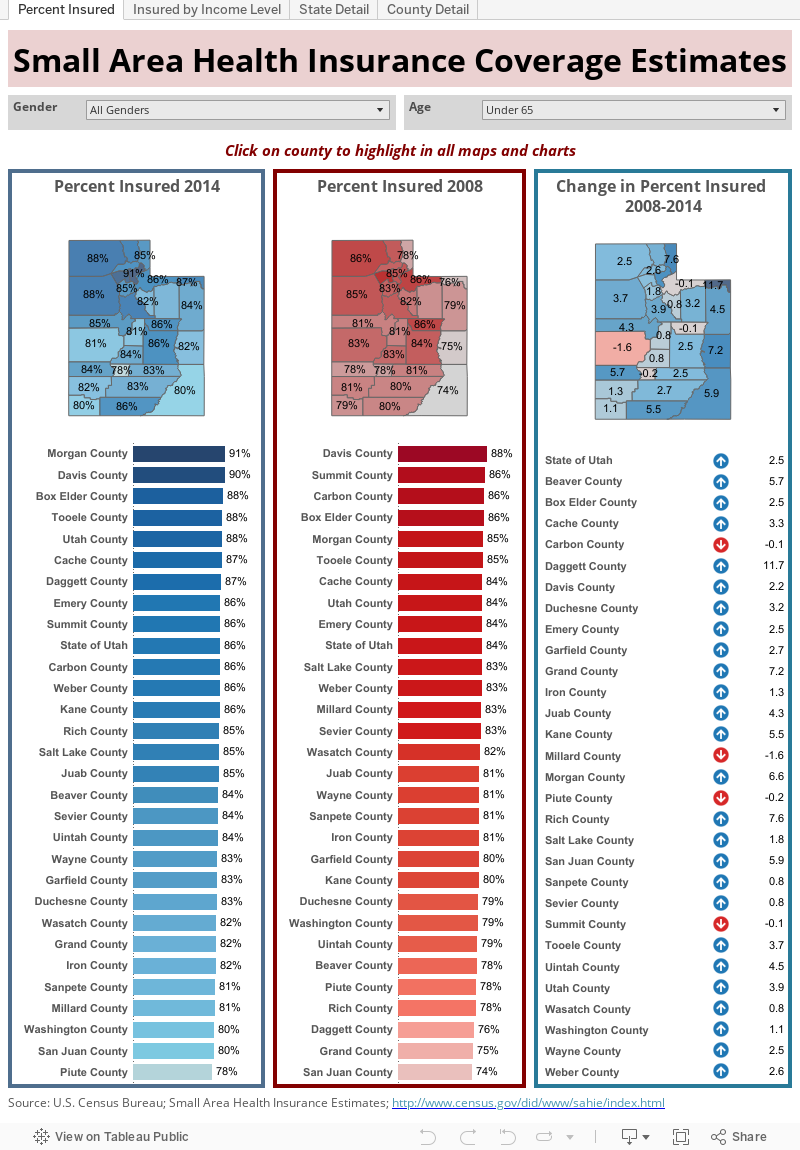
Has health insurance coverage has expanded in the Beehive State? The percentage of individuals in Utah with health insurance coverage did increase between 2009 and 2014. In 2008, 83.7 percent of the population under age 65 had some sort of health insurance according to the Census Bureau estimates (based on the American Community Survey data). By 2014, coverage had increased by an additional 2.5 percentage points to measure 86.2 percent.


However, while most age groups showed expanding coverage, coverage for persons between 40 and 64 actually declined. In fact, coverage contracted by almost a full percentage point for those 50 to 64 years of age. On the other hand, young people under the age of 19 saw the strongest expansion in coverage.

Gains in the percentage of insured proved particularly strong for African Americans and Latinos. Coverage for black Utahns increased by 5 percentage points while Hispanics experienced a notable 8 percentage-point gain. In contrast, white (not Hispanic) coverage increased by only 1.8 percentage points between 2008 and 2014.

Males (up 2.7 points) were slightly more likely than females (up 2.2 points) to experience an increase in the insured share of the population. Latino males experienced the strongest expansion, the percent of insured rose 9.1 percentage points between 2008 and 2014.

The Census Bureau provides health-insurance categories ranging from at-or-below-138 percent of poverty to at-or-below-400 percent of poverty. Those with the lowest incomes experienced the greatest increase in coverage (up 6.6 points). However, lower-income individuals are still insured at a lower rate than their higher-income peers. For example, only 73.6 percent of those at or below 138 percent of poverty are insured compared to 86.2 percent of the general population.

Counties in the northern part of the state tend to show the highest shares of insured individuals. In 2014, Morgan, Davis, Box Elder, Tooele and Utah counties all showed insured shares of 88 percent or higher. On the opposite end of the scale, many counties in central and southern Utah showed low insured rates. In Piute, San Juan, Washington, Millard and Sanpete counties, 81 percent or less of the population under the age of 65 had health insurance.

While most counties shared in the state’s increasing health insurance coverage, Carbon, Millard, Piute and Summit counties all showed a slight decrease in the share of insured individuals less than 65 years of age. However, the estimated declines are well within the margin of error for these counties, which suggests that coverage might not have declined at all. In general, the largest increases in health insurance coverage occurred in small counties — Daggett, Beaver, Grand, Kane, Morgan and San Juan counties.

Tuesday, April 26, 2016

Construction starts for medical school set to open fall 2017 in Ivins

Construction for Utah’s second medical school is set to begin this week. The Rocky Vista University College of Osteopathic Medicine, a for-profit school based in Colorado, is working to get its new campus in Ivins up and running quickly. Construction will start with the main building, located at Center Street and 200 East, and last through about June 2017 with the first class of students arriving that fall. The school expects to admit 125 people the first year. The two-story main building is 104,000 square feet on a 30-acre campus. KSL News

Thursday, March 10, 2016

Additions to SunRiver, Little Valley area get nod

The St. George City Council gave unanimous approval to a zone change amendment that paves the way for several hundred townhome-style units that would hug Interstate 15 near the Arizona border. Although the “Villas” would follow the area’s 55-and-older retirement community theme, the development would technically be separate from SunRiver, with its own homeowners association and different uses, including space for townhomes and short-term rental units that would be managed by a professional management company. Up to 45 percent of the properties could be used as short-term rentals.

The council also approved a general plan amendment to accommodate plans for a new medical clinic proposed by Intermountain Healthcare on four acres at the northwest corner of the intersection of 1450 South and 3000 East. IHC has proposed building a clinic in the area, which officials said they hope to operate similarly to how they run the Sunset Clinic and InstaCare on Sunset Boulevard on the other side of the city.

In addition, approval was given for a $1.75 million bid to build a new addition at the city’s fleet maintenance facility. St. George performs its own vehicle maintenance and repairs on-site at the facility, including police and fire vehicles, SunTran buses, street-cleaning equipment and other vehicles. The Spectrum

Tuesday, January 26, 2016

Ivins medical school to begin construction in March

Construction on the Rocky Vista University College of Osteopathic Medicine-Southern Utah is slated to begin the first week of March. The facility is planned to be completed within 14 months. The only other medical school within the state is the University of Utah, which has students practice allopathic medicine. Doctors of Osteopathic Medicine, which Rocky Vista specializes, receive training in the musculoskeletal system in addition to the traditional medical school curriculum.
The first class of 125 students will be admitted summer of 2017. Approximately 35 full-time educators and 47 administrative staff will be hired resulting in an 8 to 1 teacher-student ratio, school officials said. The Spectrum

Thursday, November 19, 2015

Dixie Regional announces $300M expansion to River Road campus

Intermountain Healthcare’s Dixie Regional Medical Center in St. George has announced an expansion to its River Road campus that will double the size of the hospital’s facilities and cost an estimated $300 million.

The demand for medical services has increased along with the area’s population, with total admissions rising to 21,080 in 2014 compared to 19,350 in 2013. The project is currently in the design phase with groundbreaking scheduled for spring of 2016 and completion expected in mid-2018.

Two new patient towers and some additions to the existing facility will total an additional 400,000 square feet, doubling the size of the hospital’s facilities. In addition to the new towers, a new 80,000 square-foot facility will be constructed near the River Road towers to house cancer care and research. St. George News

Tuesday, December 9, 2014

Parowan Chamber welcomes three new businesses

Ribbon was cut first at beauty and tanning salon Just Teasin' and Tannin.' Parowan Bone and Joint Family Clinic on 14 N. Main St. was the second ribbon cutting. Brad Mangum, who is the owner of the clinic, recently moved to Parowan from Wyoming. Finally, Renew, located at 71 N. Main St., was the last ribbon cutting of the morning. Specializing in selling vintage items, Renew takes shoppers back in time as they stroll through the store. The Spectrum

Wednesday, November 12, 2014

Dixie Regional Medical Center to add new building

Eleven years after Dixie Regional Medical Center moved most of its adult care services into a brand new campus on River Road, the hospital’s administration is preparing to consolidate its remaining services by moving women’s and children’s staff to River Road from the aging 400 East hospital campus.

The hospital received approval from the statewide medical network’s governing board about a week ago to complete the transition of services, which includes plans for a new building on the northwest side of the River Road campus at a cost to Intermountain of about $182 million. The building project is expected to add more than 270,000 square feet of hospital space.

The new building will be about 30 percent larger than the 400 East campus facility as planned and nearly double the space used by the $65 million Health and Human Performance building, which was the most recent addition to the River Road campus in 2009. The Spectrum

Garfield Memorial Hospital holds groundbreaking ceremony for remodel, addition

Garfield Memorial Hospital held a groundbreaking ceremony for their new remodel and expansion of their long-term care unit expected to be completed by spring 2015. The hospital will be adding around 1,200 square feet of additional space for physical therapy and doubling the dining room and recreational area space, as well as installing new carpet, wall coverings and furnishings. St. George News

Tuesday, September 30, 2014

Construction begins on new assisted living center

Watts Construction broke ground recently for The Retreat at Sunbrook Assisted Living, a new center located on Dixie Drive. The 58,000 square-foot facility will offer 64 units, 14 of which are intended to be used for patients suffering from memory loss. Watts Construction officials indicated the project will take about nine to 10 months to complete. The Spectrum

Monday, September 15, 2014

Veterans home opens dedicated community for rehab care

The Southern Utah Veterans Home began receiving patients at one of its “communities” that will now be dedicated to rehabilitation and recovery services, including veterans who are not living at the veterans home. The rehabilitation service has already been available at the facility, but the recent admission marks the opening of a community wing dedicated to short-term residents who, before, were intermingled with long-term residents throughout the home. The veterans home hired additional nursing staff for the dedicated wing and is anticipating an opening ceremony later this month or in early October. The Spectrum

Tuesday, August 26, 2014

St. George Detox Hospital opens 12-bed facility

Officials of the recently opened St. George Detox Hospital said coming off of an addiction is a continuing process, and they hope to make the patients’ first step easier by offering a detox environment surrounded by medical professionals and a “caring” staff. The hospital, 120 W. 1470 South, building B, is a 12-bed facility with most of its rooms housing two residents between four to nine days each, depending on the individual’s addiction and how heavily they were involved with the drug. The Spectrum

Monday, March 24, 2014

Got Health Insurance?

Insurance deadlines under Affordable Care Act are looming. Plus, the U.S. Census Bureau just released its Small Area Health Insurance Estimates for 2012. What better time to examine just who is lacking health insurance coverage in southwest Utah?

Click to Enlarge
The Census Bureau uses American Community Survey data to make estimates of health insurance coverage for every county in the United States. Both those with government-provided insurance (such as Medicaid) and private health insurance are categorized as “insured” in the data tabulations. Estimates are provided only for those 65 years and older as this age group is covered by Medicare. Age, gender, income and race/ethnicity (statewide only) breakouts are available. Remember that the margins of error for small counties may be quite high.