Showing posts with label Population. Show all posts

Tuesday, April 7, 2020

The U.S. Census Bureau Releases County Population Estimates for 2019

Next year, actual counts from the decennial census will be available

By Lecia Parks Langston, Senior Economist
“Any time you have population growth, there are business opportunities.” Roland Dorson
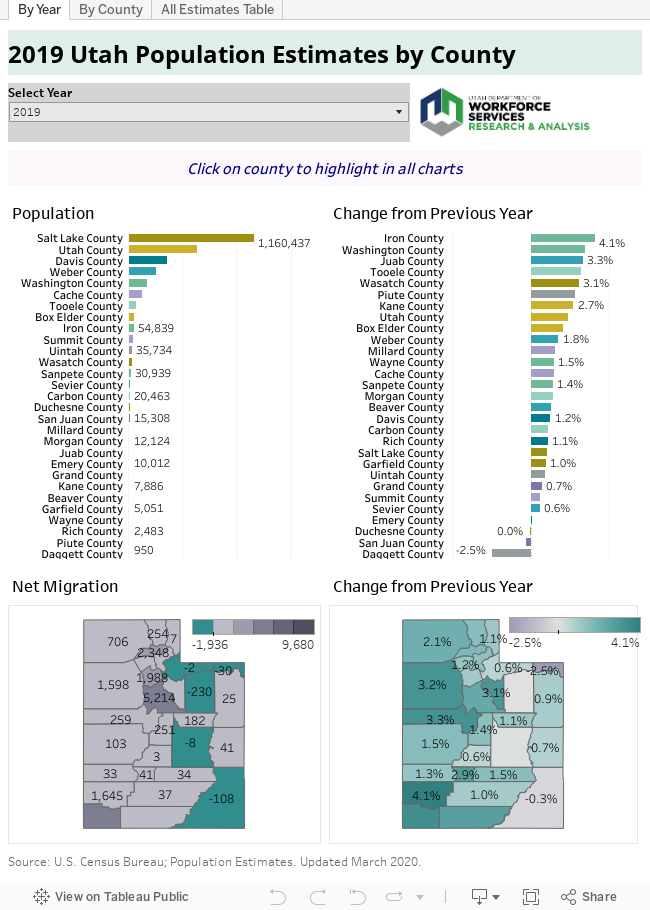
 
Hopefully, all Utahns are taking a break from COVID-19 concerns to respond (by phone, online or by mail) to their 2020 Census questionnaires (https://2020census.gov/). Since the Census results help determine how billions of dollars in federal funding are spent, accurate counts are important in order for Utah’s communities to get their “fair share.”
 
Because the actual counts are not yet available, the U.S. Census Bureau has just released the last set of population estimates for the decade. What do they show?


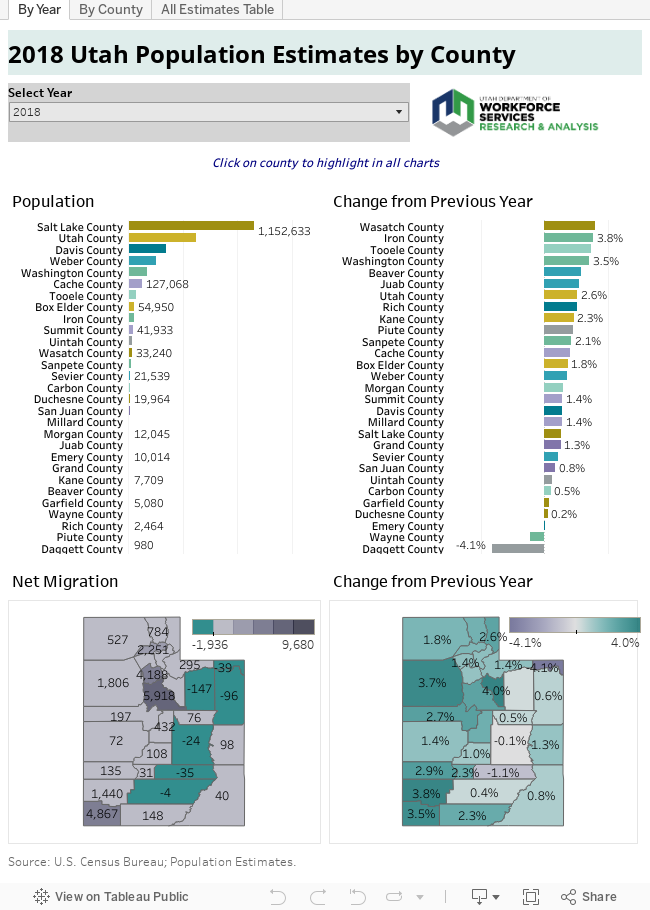
  • Iron County took the lead in population growth rates for 2019 — up by 4.1%. Following close behind was its neighbor, Washington County, with a growth rate of 3.5%.
  • Other fast-growing areas included counties at the edge of urban spread, such as Juab, Tooele and Wasatch.
  • Although Piute County saw an increase of only about 30 individuals, its small base population also resulted in a strong percentage increase (2.9%).
  • Utah County showed the highest percentage increase (2.4%) of the big-four Wasatch Front counties.
  • Estimates for both San Juan and Daggett counties suggested a decline in population, while Duchesne County’s population appeared to hold steady.
  • Utah County experienced the largest numeric gain in population — nearly 15,000 residents, followed by Salt Lake County (up about 12,000) and Washington County (up nearly 6,000).
  • Utah and Washington counties finished neck-and-neck in the race for net in-migration. Utah County’s net in-migration measured 5,200 compared to 5,100 for Washington County.
  • Several counties displayed net out-migration. Most notable on the list were Duchesne and San Juan counties. Daggett, Emery and Summit counties showed lesser out-migration estimates.
  • For its size, Utah County shows a relatively high number of births and a low number of deaths, placing its natural increase not far behind population-dense Salt Lake County.
  • Although Washington and Cache counties showed roughly equivalent numbers of births, deaths in Washington County measured much higher.
  • In 2019, Emery County experienced its first (albeit small) population growth in more than a decade.
  • Morgan County’s 2019 growth rate slipped below the state average for the first time this decade.
  • Wayne County saw its best population growth (1.5%) of the past 10 years in 2019.
  • Between 2010 and 2019, Wasatch County was the third fastest growing county in the nation. Washington County (St George, UT MSA) was the fifth fastest growing metropolitan area in the United States between 2010 and 2019. Its relatively small size contributes mathematically to a high growth rate. The Provo-Orem, UT MSA ranked ninth.
These aren’t the only estimates in town. The Kem C. Gardner Policy Institute at the University of Utah has assembled the Utah Population Committee (UPC) to reinstitute the population-estimates work previously conducted by the Utah Population Estimates Committee (UPEC). These estimates can be found here.
U.S. Census Bureau estimates use the same methodology in producing population figures for every county in the nation. Therefore, for nationwide comparisons, U.S. Census Bureau estimates may have the advantage. On the other hand, UPC population estimates have the benefit of local-analyst expertise and additional data sources.

Thursday, June 1, 2017

Is Your Town Growing?

U.S. Census Bureau releases 2016 City Population Estimates


By Lecia Parks Langston, Senior Economist

“A city is more than a place in space, it is a drama in time” –Patrick Geddes

Most of Utah’s cities and towns grew in 2017, according to population estimates recently released by the U.S. Census Bureau. Lehi even ranked 11th among the nation’s fastest-growing large cities. However, not all Utah’s cities and towns experienced growth.

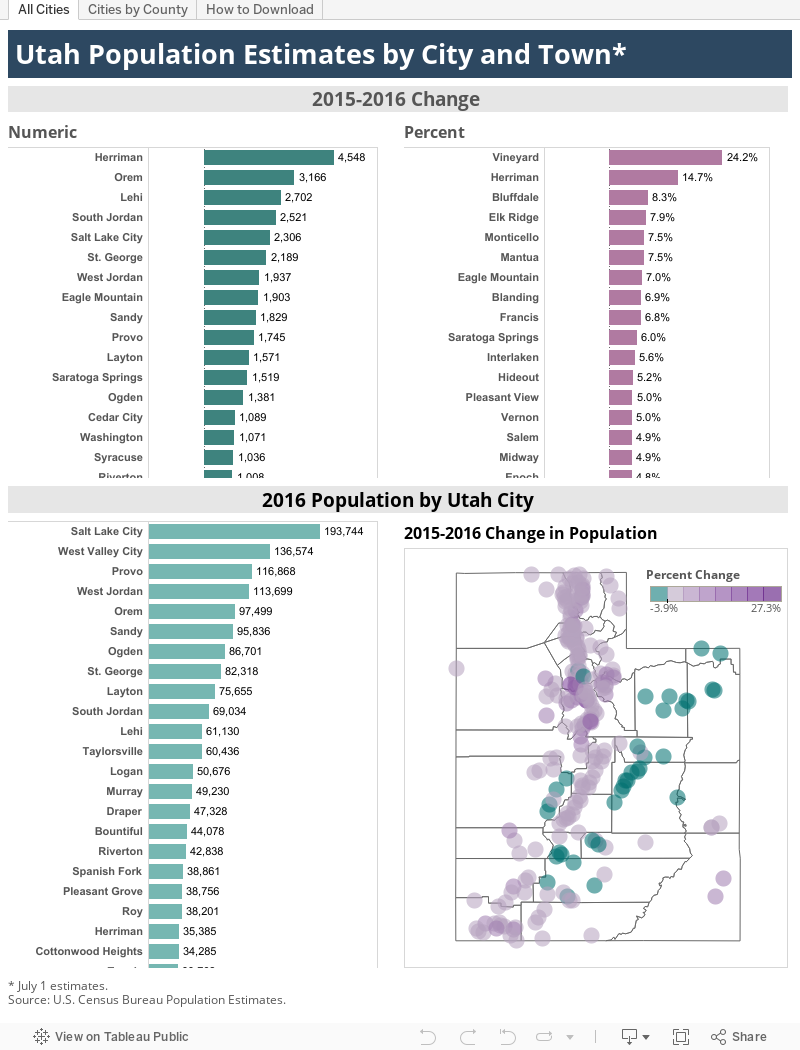
Use the visualization and bullet points below to explore population trends for individual townships.


• The old Geneva Steel Mill site continues to be fertile ground for population expansion. Vineyard was once again the fastest growing city in Utah. However its rate of growth has slowed dramatically since 2015. In addition, Vineyard remains relatively small in size.

• Herriman added the highest number of new residents of any city in Utah (4,550) followed by Orem, Lehi and South Jordan. All showed higher population gains than Salt Lake City — Utah’s most populous city. Herriman also showed the second-fastest rate of expansion in 2016.

• St. George was the only city outside the Wasatch Front to increase its population by more than 2,000 residents.

• The top four population-gaining cities in Utah are all located in southern Salt Lake County or northern Utah County, as the metropolitan population continued to spread outward from the large city centers. Fastest-growing larger communities also tended to be located near the Salt Lake County/Utah County border.

• Due to the nature of percent-change mathematics, several small towns (such as Monticello, Mantua, Francis, Interlaken and Hideout) showed high growth rates although their new-resident counts measured relatively low.

• The Census Bureau estimates that most of the cities and towns showing population declines were located in the Uintah Basin, Carbon County and Emery County. Declines in resource-based employment have spearheaded these population declines.

• In addition, Millard, Piute, Garfield and Wayne counties displayed a significant number of contracting townships.

• Salt Lake County remains home to five of the 10 largest cities in the state. Utah County accounts for another two in the top 10. St. George is the only city in the top-10 ranking located outside the Wasatch Front.

Tuesday, May 9, 2017

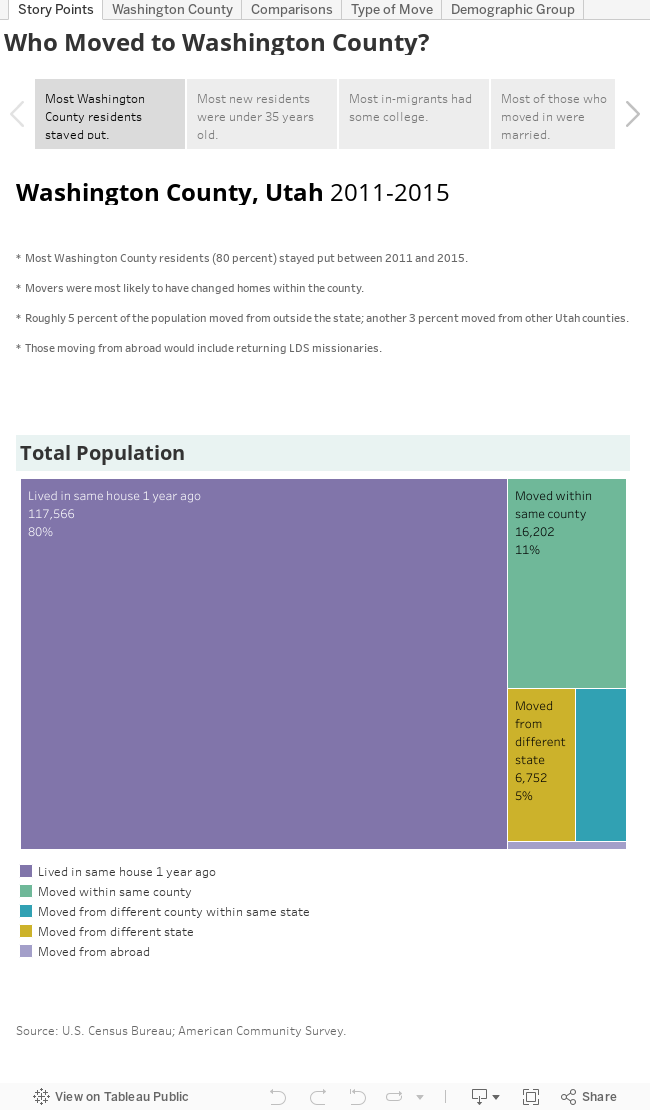
Who Moved to Washington County?

The Characteristics of Washington County In-migrants


By Lecia Parks Langston, Senior Economist

“Human beings are the only animal that thinks they change who they are simply by moving to a different place.” Douglas Coupland

In the past several decades, strong population growth has seemed like a way of life in Washington County. As the county’s population has swelled, growth rates have declined. However, large numbers of people still migrate to the area to enjoy its natural beauty and lifestyle. Who are these in-migrants? Conventional wisdom would tell you in-migrants are mostly senior citizens. However, data from the U.S. Census Bureau’s American Community Survey tells a different story.

The following visualization includes demographic averages of Washington County in-migrants for the years 2011 through 2015 (the most recent data available). Click through the gray header boxes for the basic story. Then to dig deeper, use the tabs at the top of the visualization.

Friday, March 31, 2017

What's Your County's Population?

U.S. Census Bureau releases 2016 county population estimates.


By Lecia Parks Langston, Senior Economist

“In a region with a growing population, if you’re doing nothing, you’re losing ground.” Stewart Udall

The Census Bureau just released population estimates for counties and metropolitan statistical areas across the United States. Yes, it was just a few months ago that Utah made headlines as the fastest-growing state in the nation. So, it should come as no surprise that several Utah sub-areas also appeared on the fastest-growing lists.

San Juan County ranked as the fastest growing county in the nation with a 2016 growth estimate of 7.6 percent. Keep in mind that less than 17,000 people live in the county. In other words, a small numeric change in this less-populated county can result in a large percent change.

In addition, three Utah regions ranked among the top 20 fastest-growing Metropolitan Statistical Areas in the country. The St. George, Utah MSA (sixth), Provo-Orem, Utah MSA (seventh) and the Logan, Utah-Idaho MSA (20th) all attained top-20 status. See additional information on the estimates after the “jump.”


Pick a Number, Any Number


Because the Census Bureau actually counts the population only once every decade, these figures are estimates. Plus, they aren’t the only estimates in town. The Kem C. Gardner Policy Institute has recently assembled the Utah Population Committee (UPC) to reinstitute the population-estimates work previously conducted by the Utah Population Estimates Committee (UPEC). The estimates can be found here.

Census Bureau estimates use the same methodology in producing population figures for every county in the nation. Therefore, for nationwide comparisons, Census Bureau estimates may have the advantage. On the other hand, UPC population estimates have the benefit of local-analyst expertise and additional data sources.

Monday, May 23, 2016

Most Southern Utah cities show population growth in 2015

The U.S. Census Bureau releases 2015 population estimates for cities 

By Lecia Parks Langston, Senior Economist 

“I come from a small town whose population never changed. Each time a woman got pregnant, someone left town.” Michael Prichard

The U.S. Census Bureau just released 2015 population estimates for cities and towns. In the visualization below, you can check out the estimates for your own Utah hometown. Use the “Cities by County” tab to easily locate a particular township.


While most cities in Utah expanded during 2015, they presented a wide variety of growth experiences.

• The old Geneva Steel Mill site has proved fertile ground for population growth. Vineyard, Utah, which is located on the spot, grew by a whopping 418 percent in just one year. However, Vineyard’s population remains relatively low in the overall scheme of things with about 3,200 residents.

• South Jordan added the largest number of persons (roughly 3,800) of any Utah city or town. South Jordan also ranked fifth in the nation for 2015 population growth (among cities with populations of 50,000 or more).

• The top five population-gaining cities in Utah are all located in southern Salt Lake County or northern Utah County as the metropolitan population continues to spread outward from the large city centers. Fastest-growing larger communities also tended to be located near the Salt Lake/Utah County border.

• Due to the nature of percent changes, several small towns (Ophir, Ballard, Francis, Wallsburg) showed high growth rates although their new-resident counts measured relatively low.

• Census estimates suggest a number of towns lost population in 2015. Every town in Carbon, Emery and Wayne counties showed contraction. In addition, Kanab and Beaver City experienced notable population declines.

• Salt Lake County remains home to five of the 10 largest cities in the state. Utah County accounts for another two in the top 10. St. George is the only city in the top-10 ranking located outside the Wasatch Front.

Wednesday, May 18, 2016

Health insurance coverage improving in Southwest Utah

The Census Bureau Releases 2014 Small Area Health Insurance Estimates 


By Lecia Parks Langston, Senior Economist 

“Poverty and no health insurance coverage keeps the doctor away — apples have nothing to do with it.” Beryl Dov 

The goals of the Affordable Care Act (ACA) include expanded health insurance coverage in the United States. Most of the Act’s health insurance expansion provisions went into effect January 1, 2014. The U.S. Census Bureau’s recently-released 2014 Small Area Health Insurance Estimates  provide an initial glimpse of the early outcomes of ACA on health insurance coverage. Keep in mind that health insurance coverage runs the gamut from employer-provided plans to personal insurance to government Medicaid and Medicare coverage. These estimates cover individuals under the age of 65, since those 65 and older are eligible for government-provided health insurance through Medicare.

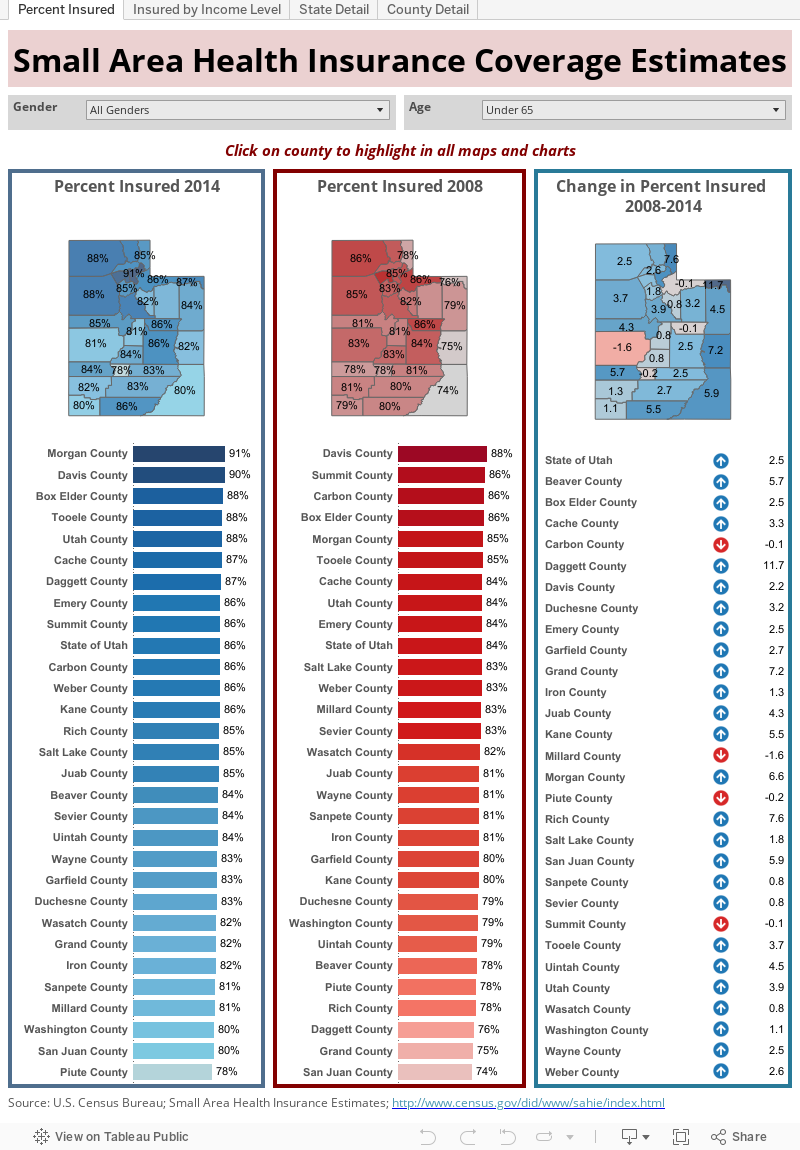
Has health insurance coverage has expanded in the Beehive State? The percentage of individuals in Utah with health insurance coverage did increase between 2009 and 2014. In 2008, 83.7 percent of the population under age 65 had some sort of health insurance according to the Census Bureau estimates (based on the American Community Survey data). By 2014, coverage had increased by an additional 2.5 percentage points to measure 86.2 percent.


However, while most age groups showed expanding coverage, coverage for persons between 40 and 64 actually declined. In fact, coverage contracted by almost a full percentage point for those 50 to 64 years of age. On the other hand, young people under the age of 19 saw the strongest expansion in coverage.

Gains in the percentage of insured proved particularly strong for African Americans and Latinos. Coverage for black Utahns increased by 5 percentage points while Hispanics experienced a notable 8 percentage-point gain. In contrast, white (not Hispanic) coverage increased by only 1.8 percentage points between 2008 and 2014.

Males (up 2.7 points) were slightly more likely than females (up 2.2 points) to experience an increase in the insured share of the population. Latino males experienced the strongest expansion, the percent of insured rose 9.1 percentage points between 2008 and 2014.

The Census Bureau provides health-insurance categories ranging from at-or-below-138 percent of poverty to at-or-below-400 percent of poverty. Those with the lowest incomes experienced the greatest increase in coverage (up 6.6 points). However, lower-income individuals are still insured at a lower rate than their higher-income peers. For example, only 73.6 percent of those at or below 138 percent of poverty are insured compared to 86.2 percent of the general population.

Counties in the northern part of the state tend to show the highest shares of insured individuals. In 2014, Morgan, Davis, Box Elder, Tooele and Utah counties all showed insured shares of 88 percent or higher. On the opposite end of the scale, many counties in central and southern Utah showed low insured rates. In Piute, San Juan, Washington, Millard and Sanpete counties, 81 percent or less of the population under the age of 65 had health insurance.

While most counties shared in the state’s increasing health insurance coverage, Carbon, Millard, Piute and Summit counties all showed a slight decrease in the share of insured individuals less than 65 years of age. However, the estimated declines are well within the margin of error for these counties, which suggests that coverage might not have declined at all. In general, the largest increases in health insurance coverage occurred in small counties — Daggett, Beaver, Grand, Kane, Morgan and San Juan counties.

Wednesday, April 20, 2016

New County Population Estimates


The U.S. Census Bureau recently released 2015 population estimates by county. See our main blog page for individual county data.

Monday, August 3, 2015

Local Insights updated on the web

By Mark Knold, Supervising Economist 

Shelter is one of humanity’s basic needs. That is why housing is everywhere. Since housing is so ubiquitous, it becomes an important component in an economy’s foundation, and as such becomes an economic indicator.

In this issue of Local Insights, we look at the demand for housing structures, the amount of housing permits and their history, and how this history shows that housing demand follows the ups and downs of a region’s economic performance. In evaluating the volume of housing permits, we also parallel the health and vitality of the local economy.

People need jobs that supply them income in order to afford housing. Jobs are not the only factor, as things like affordability and the ability to obtain lending also play their part in housing demand. But the foundation of housing demand is the health of the job market.


The graph shows Utah statewide housing permits. A trend of normal permitting activity is evident from 1996 through 2004. Permits rose during the pre-Great Recession boom, then became lethargic for the seven years following. It is just recently that the volume of permit activity is again approaching something normal. That in itself is an economic indicator of an improved Utah economy.


--------------------------------------------

To read more, see the latest issues of Local Insights. To receive a printed copy, please call 801-526-9785.