The Utah Department of Workforce Services releases Skill and Knowledge-based Projections
By Lecia Parks Langston, Senior Economist“It is possible to fly without motors, but not without knowledge and skill.” Wilbur Wright
The following skill and knowledge projections suggest that the foundation for future workforce preparation relies on those old favorites “readin' and 'ritin' and 'rithmetic.” Technical skills and knowledge areas are also important, but rely on an excellent foundation in basic skill and knowledge areas.
• Utah occupational projections and the Occupational Information Network (O*Net) provide the foundation for these skills and knowledge estimates.
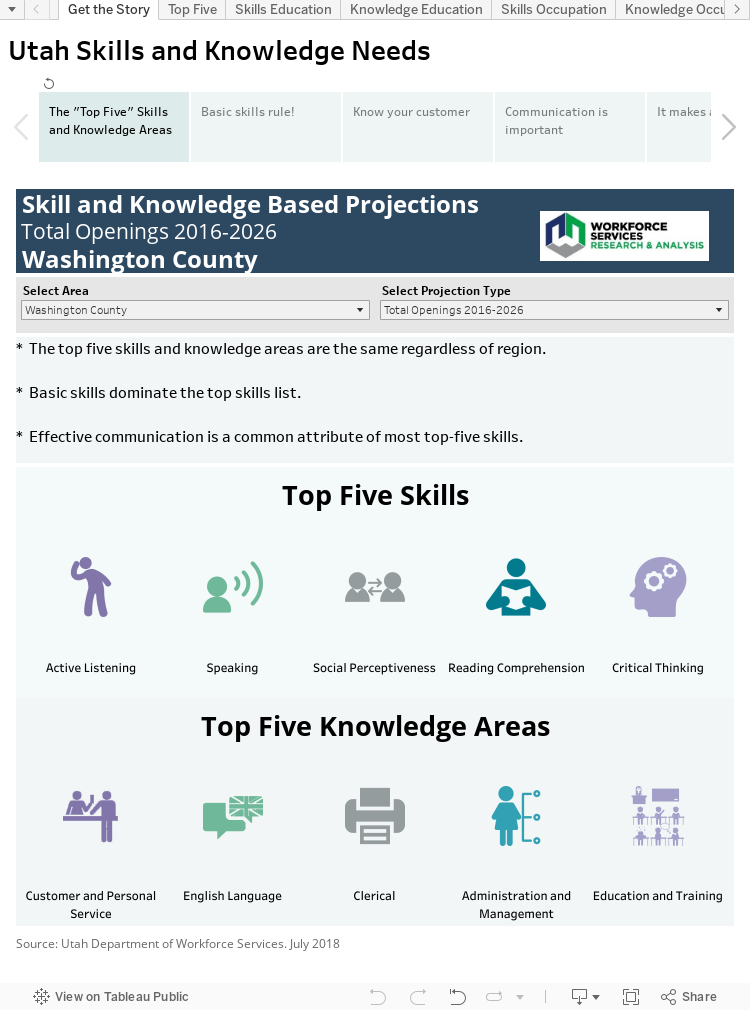
• “Basic Skills” dominate the top 10 in-demand skills, suggesting a need to ensure training on “the basics” for all prospective workers.
• Basic skills needs cross occupational and educational boundaries. • Basic skills make changing occupations possible as the labor market changes.
• Communication skills and reading rank highest on the top skills list, followed by critical thinking. • The top five skill and knowledge areas are the same for every region of the state.
• The top 10 in-demand skills change very little regardless of the occupational training level.
• Customer Service ranks, by far, as the knowledge area with the highest projected demand.
• For occupations requiring formal training past the high school level, competence in English, computers/electronics, and mathematics becomes increasingly important — although these skills are in demand for employment at all training levels.
• Short-term shortages for certain technical skills may seem to displace the overarching need for all workers to have a strong foundation in basic skills in training discussions.