Showing posts with label Retail. Show all posts
Showing posts with label Retail. Show all posts
Monday, October 14, 2019
Last Kmart in Utah expected to close its doors in St. George
The last Kmart in Utah, located in St. George, will close its doors before the end of the year. Earlier this month, Transform Holdco, the privately-owned company that acquired Sears Holdings Corporation’s assets this year, announced the closure of five Kmart locations and a number of Sears stores across the country. Now, Transform Holdco officials have confirmed that the last Kmart in Utah, located on Bluff Street in St. George, will be one of over 100 other Kmart and Sears locations to close. The liquidation sale is expected to begin in mid-September, and the store is scheduled to close by mid-December. St George News


Monday, May 21, 2018
Long-awaited Joule Plaza breaks ground in downtown St. George
The future site of Joule Plaza, a mixed-use project that has been in the works for many years, played host to a groundbreaking ceremony. Estimated to be completed by summer 2019, the project will feature both residential and commercial space.
The project is located across the street from the 5th District Courthouse on Tabernacle Street, dominating much of the block between 200 and 300 West, and covers approximately 4 acres. It will feature 19,100 square feet of commercial space, as well as offer amenities for residents that aren’t generally available in the downtown area.
Joule Plaza will sport three four-story buildings and consist of studio and one- and two-bedroom apartments. According to the project’s website, the apartments will have high-end features like granite counter tops, wood plank tile, balconies and high-speed fiber internet. It will also include common areas, a fitness center for residents and a pool. St George News
The project is located across the street from the 5th District Courthouse on Tabernacle Street, dominating much of the block between 200 and 300 West, and covers approximately 4 acres. It will feature 19,100 square feet of commercial space, as well as offer amenities for residents that aren’t generally available in the downtown area.
Joule Plaza will sport three four-story buildings and consist of studio and one- and two-bedroom apartments. According to the project’s website, the apartments will have high-end features like granite counter tops, wood plank tile, balconies and high-speed fiber internet. It will also include common areas, a fitness center for residents and a pool. St George News
Wednesday, February 14, 2018
Record number of sports participants bring in over $78 million to St. George in 2017
Healthy competition has been good for the economy in Washington County. In 2017, 42 major athletic events brought more than 62,000 participants and over 116,000 out-of-town visitors to the area. The result was a whopping $78 million in direct economic impact, according to a news release from the St. George Area Sports Commission, thousands in tax relief for residents and hundreds of thousands more in media exposure for the area. St George News
Cedar City Business Openings and Closings
Das Nest—Located next to the Knight’s Inn on South Main Street, this new restaurant is bringing international cuisine to Cedar City each week. Das Nest is open every Friday and Saturday night with a limited menu featuring international dishes from a pre-selected country.
Iron County Courthouse—The Iron County Courthouse has re-opened in Parowan after being closed for more than a year for renovations. The $2.5 million project focused on fixing the outdated plumbing and electrical systems of the 42-year-old building.
Courtyard Marriott—Cedar City’s newest hotel is officially open. The 100-room hotel features a meeting and banquet hall in addition to four separate spaces for break-out sessions.
Porkbelly’s Express and Purple Oasis Acai Bowls & Smoothies—Two Cedar City staples have now found a home at Southern Utah University. Following the lead of Fat Zeus, Purple Oasis Acai Bowls & Smoothies has now transformed from a food truck to a storefront in the Sharwan Smith Student Center. Purple Oasis offers a menu of healthy food and smoothies, including the trendy acai bowl.
Nature’s Grocer—Nature’s Grocer quietly opened on south Main Street at the end of 2017 near Retro Fitness and the IFA. The health food store carries a variety of nutrition products, herbs, supplements and bulk foods.
Tagg N Go Express Car Wash—A Tagg N Go Express Car Wash is under construction on South Main Street near Ross. Construction is expected to be completed by June or July. Walmart—Walmart is about to undergo a major renovation starting in mid-February. According to a representative for the international chain superstore, the upgrades will include new paint and flooring.
Main Street Grill—The downtown breakfast and lunch spot shuttered early this year. The exact reason behind the closing of Main Street Grill is unknown, but it looks like the coveted space is already undergoing a makeover.
Funky Monkey Arcade—After multiple ownership changes since opening in 2016, Funky Monkey Arcade on south Main Street has officially shut its doors. The Spectrum
Iron County Courthouse—The Iron County Courthouse has re-opened in Parowan after being closed for more than a year for renovations. The $2.5 million project focused on fixing the outdated plumbing and electrical systems of the 42-year-old building.
Courtyard Marriott—Cedar City’s newest hotel is officially open. The 100-room hotel features a meeting and banquet hall in addition to four separate spaces for break-out sessions.
Porkbelly’s Express and Purple Oasis Acai Bowls & Smoothies—Two Cedar City staples have now found a home at Southern Utah University. Following the lead of Fat Zeus, Purple Oasis Acai Bowls & Smoothies has now transformed from a food truck to a storefront in the Sharwan Smith Student Center. Purple Oasis offers a menu of healthy food and smoothies, including the trendy acai bowl.
Nature’s Grocer—Nature’s Grocer quietly opened on south Main Street at the end of 2017 near Retro Fitness and the IFA. The health food store carries a variety of nutrition products, herbs, supplements and bulk foods.
Tagg N Go Express Car Wash—A Tagg N Go Express Car Wash is under construction on South Main Street near Ross. Construction is expected to be completed by June or July. Walmart—Walmart is about to undergo a major renovation starting in mid-February. According to a representative for the international chain superstore, the upgrades will include new paint and flooring.
Main Street Grill—The downtown breakfast and lunch spot shuttered early this year. The exact reason behind the closing of Main Street Grill is unknown, but it looks like the coveted space is already undergoing a makeover.
Funky Monkey Arcade—After multiple ownership changes since opening in 2016, Funky Monkey Arcade on south Main Street has officially shut its doors. The Spectrum
Thursday, January 18, 2018
New Developments announced at Washington County Economic Summit
A proposal is underway to build a large apartment complex, hotel and shopping center along the block at the southwestern corner of the intersection of Main Street and St. George Boulevard. PEG Development has broken ground on the $40 million "City View" project, which has been touted as a major part of the effort to revitalize the downtown area.
In Washington City, the proposed Grapevine Crossing would involve the development of a 288-acre collection of shopping, parks and public facilities that city officials are describing as a type of village-style "experience" destination where families can play, shop, eat and be part of the community. The Spectrum
In Washington City, the proposed Grapevine Crossing would involve the development of a 288-acre collection of shopping, parks and public facilities that city officials are describing as a type of village-style "experience" destination where families can play, shop, eat and be part of the community. The Spectrum
Thursday, January 4, 2018
Construction starts on $40 million 'City View' downtown St. George project
Developers gathered with representatives from the City of St. George to turn ceremonial shovels and signal the beginning of construction on a $40 million multi-use project pegged as a key step in building up the downtown area.
The "City View" project is planned to include a planned four-story Boutique hotel, two four-story apartment buildings, retail shopping, restaurants and other commercial uses. The first phases, one of the apartment buildings and a parking structure, should be open by next fall. About 110 apartment units would be included. The Spectrum
New Cedar City Businesses
Several new businesses have opened or will open in Cedar City including Cup of Joe, a drive-thru coffee shop; Noggin Games, which caters to family gaming; The Stork on Main, a baby boutique; Harbor Freight Tools, a California-based hardware store; Hauptstrasse Markt, a German deli and the Courtyard Marriott hotel. The Spectrum
Tuesday, November 28, 2017
New businesses coming to Exit 13 in Washington
City officials are beginning to see a longtime goal of continuing commercial development along Washington Parkway come to fruition with the recent groundbreaking for an incoming diner and the announcement of a hotel nearby.
Currently the only business in the area, located on the east side of Interstate 15’s Exit 13 leading to Washington Parkway, is a Maverik convenience store and gas station. That is changing, though, with an Oct. 25 groundbreaking for a Black Bear Diner across the street to the south. Located to the east of Maverik is a large parcel of land with two signs. One shows an artist’s rendering of a potential “commerce and hospitality center” slated for the spot; another announces a forthcoming Best Western Plus hotel. St. George News
Currently the only business in the area, located on the east side of Interstate 15’s Exit 13 leading to Washington Parkway, is a Maverik convenience store and gas station. That is changing, though, with an Oct. 25 groundbreaking for a Black Bear Diner across the street to the south. Located to the east of Maverik is a large parcel of land with two signs. One shows an artist’s rendering of a potential “commerce and hospitality center” slated for the spot; another announces a forthcoming Best Western Plus hotel. St. George News
Monday, August 14, 2017
New Smith’s Marketplace Open in St. George
A new Smith’s Marketplace is now open at Dinosaur Crossing in St. George. The 123,000 square-foot store will add 257 new jobs to the area and offer and assortment of groceries, apparel, housewares and small kitchen appliances. The Spectrum
Wednesday, July 26, 2017
“New and Improved?” A look at the Retail Trade Industry in Southwest Utah
By Mark Knold, Supervising Economist and Lecia Parks Langston, Senior Economist
“Almost no one wants to admit the genius of Jeff Bezos and Amazon. Apparently, many have failed to see that Amazon has become the world's biggest retail company.” Hubert Burda
Consumer spending makes up around 68 percent of the nation’s gross domestic product. Consumer spending is individuals and families purchasing groceries, clothing, recreation, stocks, insurance, education and much more. The transactions cover a broad swath of economic activity.
Much of the nation’s consumer spending is captured via retail trade. A useful retail trade definition is “the re-sale (sale without transformation) of new and used goods to the general public, for personal or household consumption or utilization.” Not all consumer spending is captured through retail trade transactions, but a large share is.
Broad-category examples of retail trade sectors are motor vehicle sales, furniture stores, electronic stores, building material stores, grocery stores, pharmacies, gas stations, clothing stores and department stores, among others.
Then there is the relatively new and emerging part of the retail trade sphere — non-store retailers. These are establishments that sell products on the internet. Examples include Amazon, Zappos, Overstock.com, or eBay. These types of retailers have grown rapidly in the past 15 years and their presence is reshaping the retail trade landscape.
Whereas in the past nearly all retail transactions were done through traditional brick-and-mortar stores, now a significant and growing segment is diverted to internet sales. The consumer shops online and goods are delivered to the customer’s doorstep. One can see that the number of brick-and-mortar stores and the level of local sales across the country are being endangered by this economic evolution.
The brick-and-mortar reduction is beginning to show its economic presence in the United States employment numbers. While the U.S. economy is finally expanding at a healthy pace this side of the Great Recession, one of the few industries not rising with this tide is retail trade. While overall retail sales are increasing, employment is not.
Traditionally, as a population increases, retail trade employment grows simultaneously, since population growth and consumer spending volume is an integrated dynamic. If studied deeply, a certain ratio of retail trade employment growth spawned from population growth would emerge. Before the internet, the vast majority of all consumer sales occurred in the immediate community or region. But now, the internet is diverting these sales away from the local community — and with internet sales growing, its market share will increase.
We do not yet know how much brick-and-mortar erosion will eventually occur. And will such a phenomenon hit some areas more than others (e.g., urban vs. rural, or local vs. tourist spending)? These are touch points that economist will be watching as this Internet sales phenomenon continues to grow within the national and Utah economies.
In light of this change, in this quarter’s Local Insights we are profiling retail trade employment throughout Utah’s local regions. This can offer a profile of where retail trade is now in a local economy, and possibly how much of the sector could become vulnerable to the internet-sales phenomenon.
All regions can be viewed through the Local Insights web portal. The following is a retail trade profile for the Southwest region:
Just how important is retail trade employment in the southwest corner of Utah? In 2016, roughly 12,400 Southwest Utah workers were employed in retail trade representing 14 percent of total nonfarm employment in the region. That’s slightly higher than the statewide retail average of 12 percent. The current employment level represents a regional high point. Moreover, despite the revolution in online buying, employment in retail trade has trended upward in Southwest Utah — although it has ebbed and flowed during boom, recession and recovery. Of course, the region’s population growth provides a major factor in retail trade employment expansion in Southwest Utah.
In most Southwest Utah counties, growth rates swelled in the mid-2000s, toppled during the recession and surged back as the recovery took hold. Yes, retail trade is certainly susceptible to the business cycle. During the recovery, Garfield County led the pack with early retail trade gains only to experience job losses when other counties picked up speed. In contrast, both Kane and Iron counties were slow to add retail jobs in the recovery period. Retail trade employment in both counties just barely returned to the pre-recession peak levels.
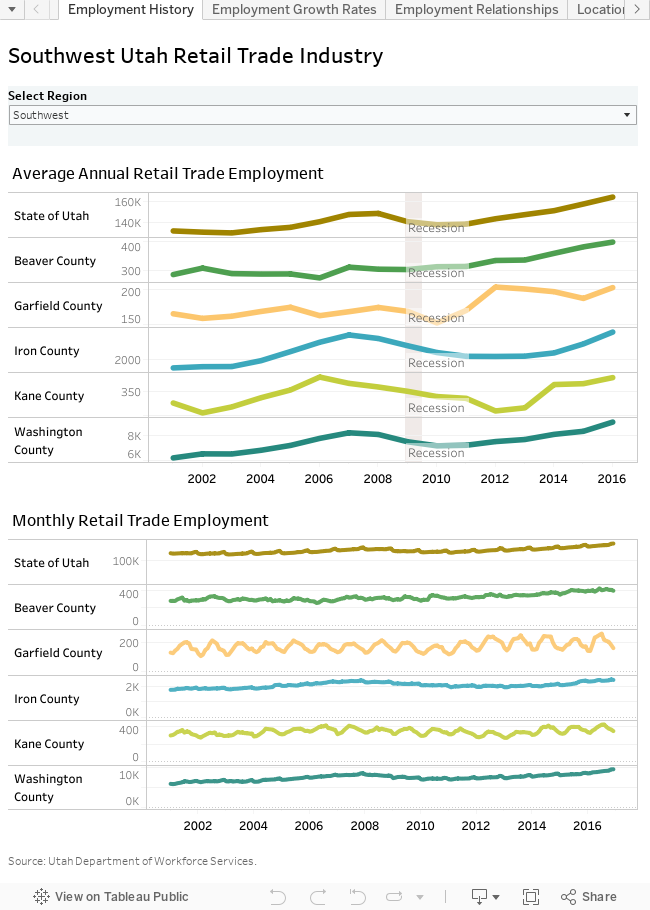
Retail trade employment can be very seasonal in nature. In both the Garfield and Kane economies, a strong tourism and recreation component produces a significant seasonal pattern with employment peaking in the summer months and bottoming out in January or February. In Garfield County, retail trade jobs can double between trough and peak. While tourism isn’t as profound in Beaver County, retail employment also peaks in summer as the industry services travelers along the I-15 corridor. Washington and Iron counties experience less seasonality, but also see their lowest retail employment levels as the year begins. However, in these two counties, holiday shopping creates a slight seasonal peak in December. This pattern follows the statewide lead.
Some counties in Southwest Utah are more dependent on retail trade employment than others. Statewide, retail trade employment accounts for about 12 percent of total nonfarm jobs. Beaver (17 percent), Washington (15 percent) and Iron (14 percent) counties all show higher percentages of retail trade employment than the state. Iron and Washington are self-contained, regional shopping centers which probably accounts for their higher-than-average retail shares.
Despite their tourism-dependent economies, Kane and Garfield counties show smaller percentages of retail trade employment overall. This is partially due to the high levels of leisure/hospitality employment in these counties. In addition, tourism’s contribution to retail trade employment typically lasts only half the year.
Location quotients (LQ) provide a different way of looking at the importance of an industry. These ratios compare an area’s industry employment share to that of the nation. A retail trade LQ of 1 indicates the area’s industry employment makes up the same share of employment as that industry does nationwide. A location quotient greater than 1 means the area’s industry has a greater employment share than the United States. Utah’s retail trade location quotient measures just higher than 1. However, Beaver, Iron and Washington counties all have retail trade location quotients of 1.3 or higher, attesting to the magnitude of retail employment in these areas. On the other hand, Kane’s LQ is exactly 1 while Garfield County shows an LQ of 0.78. In other words, retail employment is far less important in Garfield County than in other Southwest Utah counties, the state and the nation.
Over time, the share of retail trade employment has remained fairly steady in the most populated Southwest counties. On the other hand, in Beaver and Garfield counties, retail trade has taken on a more important employment role in the post-recession years.
Population per retail worker also provides insights into the retail trade industry’s local importance. Statewide there are roughly 16 residents per retail trade job. Despite being the most tourism-dependent county in Utah, Garfield County shows 24 residents per retail trade worker, the highest in the region. On the other hand, Washington County’s population per retail trade job measures less than 15, which seems to reflect its importance as a regional shopping destination. In general, the ratio of population to retail trade employment has trended downward, which seems to reflect the incursion of online shopping.
In Southwest Utah, general merchandise stores (e.g., Wal-Mart, Target, Dillards, JC Penny) account for the largest subsector share of retail trade workers — 20 percent. Food and beverage stores ran neck-and-neck with these stores with just less than 19 percent of total employment. Motor vehicle/parts dealers (13 percent), building materials/garden stores (12 percent) and gasoline stations (10 percent) are also major employment players in retail trade.
The job shares of retail trade subsectors vary between Southwest Utah and the state overall. Southwest Utah shows higher employment shares in building material and garden stores, food and beverage stores and gasoline stations than Utah. In contrast, the region shows smaller employment percentages in clothing stores, electronics stores and especially non-store retailers. In other words, Southwest Utah employment does not appear to be benefitting from online sales.
A Fair Share?
Since 2000, general merchandise stores have slowly eked out a higher share of retail trade employment. In 2000, roughly 16 percent of Southwest Utah retail employment was at general merchandise stores. Since that time, general merchandise stores have increased their share by 3 percentage points. Building material and garden stores have also seen employment shares increase as several big box retailers entered the area.
On the other hand, food and beverage stores’ share of retail trade employment has decreased slightly. The inclusion of groceries at some big-box stores has probably tapped into some of the food and beverage store employment. On the other hand, many traditional grocery stores now also carry non-grocery items.
Retail trade is not known for its excessive wages. In 2016, only private education services, and leisure/hospitality services showed lower average monthly wages in Southwest Utah. Not only are retail trade hourly wages lower than average — many jobs are part-time, which contributes to its lower-than-average standing.
Statewide, the average monthly wage for a retail trade worker measures less than $2,600. Not surprisingly, the average retail trade wage measured even lower in all Southwest Utah counties. Nevertheless, a wide disparity in wages exists even within the region. In Washington County, the 2016 average monthly retail trade wage registered at about $2,200, while in Garfield County, the average was a mere $1,400. Iron County’s wage ($2,100) measured slightly below the Washington figure. Beaver ($1,600) and Kane ($1,600) landed closer to the Garfield County wage.
Interestingly, during the pre-recession years when Washington County experienced rapid employment growth and short-term labor shortages, its average monthly retail wage actually surpassed the statewide figure. (It was that whole supply and demand thing at work.) Of course, once recession hit, wages returned to a more historical relationship.
Retail trade wages also show a notable variety in relationship to the average county wage. Statewide the retail trade industry wage measures 70 percent of average. In both Iron (84 percent) and Washington (80 percent) counties, retail trade wages compare more favorably to the overall county average. In Beaver and Garfield counties the retail wage measures about 56 percent of average; Kane County’s figure is slightly higher at about 65 percent.
Between 2001 and 2016, the gap between the retail trade industry wage and the average wage widened in all counties — and the state. This suggests that wages in other industries have increased faster than those in retail trade.
Within the retail trade industry in Southwest Utah, jobs at motor vehicle/parts dealers show the highest average wage followed by building materials and garden stores. On the low end of the scale, clothing stores paid the lowest wages.
“Almost no one wants to admit the genius of Jeff Bezos and Amazon. Apparently, many have failed to see that Amazon has become the world's biggest retail company.” Hubert Burda
Consumer spending makes up around 68 percent of the nation’s gross domestic product. Consumer spending is individuals and families purchasing groceries, clothing, recreation, stocks, insurance, education and much more. The transactions cover a broad swath of economic activity.
Much of the nation’s consumer spending is captured via retail trade. A useful retail trade definition is “the re-sale (sale without transformation) of new and used goods to the general public, for personal or household consumption or utilization.” Not all consumer spending is captured through retail trade transactions, but a large share is.
Broad-category examples of retail trade sectors are motor vehicle sales, furniture stores, electronic stores, building material stores, grocery stores, pharmacies, gas stations, clothing stores and department stores, among others.
Then there is the relatively new and emerging part of the retail trade sphere — non-store retailers. These are establishments that sell products on the internet. Examples include Amazon, Zappos, Overstock.com, or eBay. These types of retailers have grown rapidly in the past 15 years and their presence is reshaping the retail trade landscape.
Whereas in the past nearly all retail transactions were done through traditional brick-and-mortar stores, now a significant and growing segment is diverted to internet sales. The consumer shops online and goods are delivered to the customer’s doorstep. One can see that the number of brick-and-mortar stores and the level of local sales across the country are being endangered by this economic evolution.
The brick-and-mortar reduction is beginning to show its economic presence in the United States employment numbers. While the U.S. economy is finally expanding at a healthy pace this side of the Great Recession, one of the few industries not rising with this tide is retail trade. While overall retail sales are increasing, employment is not.
Traditionally, as a population increases, retail trade employment grows simultaneously, since population growth and consumer spending volume is an integrated dynamic. If studied deeply, a certain ratio of retail trade employment growth spawned from population growth would emerge. Before the internet, the vast majority of all consumer sales occurred in the immediate community or region. But now, the internet is diverting these sales away from the local community — and with internet sales growing, its market share will increase.
We do not yet know how much brick-and-mortar erosion will eventually occur. And will such a phenomenon hit some areas more than others (e.g., urban vs. rural, or local vs. tourist spending)? These are touch points that economist will be watching as this Internet sales phenomenon continues to grow within the national and Utah economies.
In light of this change, in this quarter’s Local Insights we are profiling retail trade employment throughout Utah’s local regions. This can offer a profile of where retail trade is now in a local economy, and possibly how much of the sector could become vulnerable to the internet-sales phenomenon.
All regions can be viewed through the Local Insights web portal. The following is a retail trade profile for the Southwest region:
Trending Upward
Just how important is retail trade employment in the southwest corner of Utah? In 2016, roughly 12,400 Southwest Utah workers were employed in retail trade representing 14 percent of total nonfarm employment in the region. That’s slightly higher than the statewide retail average of 12 percent. The current employment level represents a regional high point. Moreover, despite the revolution in online buying, employment in retail trade has trended upward in Southwest Utah — although it has ebbed and flowed during boom, recession and recovery. Of course, the region’s population growth provides a major factor in retail trade employment expansion in Southwest Utah.
In most Southwest Utah counties, growth rates swelled in the mid-2000s, toppled during the recession and surged back as the recovery took hold. Yes, retail trade is certainly susceptible to the business cycle. During the recovery, Garfield County led the pack with early retail trade gains only to experience job losses when other counties picked up speed. In contrast, both Kane and Iron counties were slow to add retail jobs in the recovery period. Retail trade employment in both counties just barely returned to the pre-recession peak levels.
Tis the Season
Retail trade employment can be very seasonal in nature. In both the Garfield and Kane economies, a strong tourism and recreation component produces a significant seasonal pattern with employment peaking in the summer months and bottoming out in January or February. In Garfield County, retail trade jobs can double between trough and peak. While tourism isn’t as profound in Beaver County, retail employment also peaks in summer as the industry services travelers along the I-15 corridor. Washington and Iron counties experience less seasonality, but also see their lowest retail employment levels as the year begins. However, in these two counties, holiday shopping creates a slight seasonal peak in December. This pattern follows the statewide lead.
Dependency
Some counties in Southwest Utah are more dependent on retail trade employment than others. Statewide, retail trade employment accounts for about 12 percent of total nonfarm jobs. Beaver (17 percent), Washington (15 percent) and Iron (14 percent) counties all show higher percentages of retail trade employment than the state. Iron and Washington are self-contained, regional shopping centers which probably accounts for their higher-than-average retail shares.
Despite their tourism-dependent economies, Kane and Garfield counties show smaller percentages of retail trade employment overall. This is partially due to the high levels of leisure/hospitality employment in these counties. In addition, tourism’s contribution to retail trade employment typically lasts only half the year.
Location quotients (LQ) provide a different way of looking at the importance of an industry. These ratios compare an area’s industry employment share to that of the nation. A retail trade LQ of 1 indicates the area’s industry employment makes up the same share of employment as that industry does nationwide. A location quotient greater than 1 means the area’s industry has a greater employment share than the United States. Utah’s retail trade location quotient measures just higher than 1. However, Beaver, Iron and Washington counties all have retail trade location quotients of 1.3 or higher, attesting to the magnitude of retail employment in these areas. On the other hand, Kane’s LQ is exactly 1 while Garfield County shows an LQ of 0.78. In other words, retail employment is far less important in Garfield County than in other Southwest Utah counties, the state and the nation.
Over time, the share of retail trade employment has remained fairly steady in the most populated Southwest counties. On the other hand, in Beaver and Garfield counties, retail trade has taken on a more important employment role in the post-recession years.
Relationships
Population per retail worker also provides insights into the retail trade industry’s local importance. Statewide there are roughly 16 residents per retail trade job. Despite being the most tourism-dependent county in Utah, Garfield County shows 24 residents per retail trade worker, the highest in the region. On the other hand, Washington County’s population per retail trade job measures less than 15, which seems to reflect its importance as a regional shopping destination. In general, the ratio of population to retail trade employment has trended downward, which seems to reflect the incursion of online shopping.
Down to Subsectors
In Southwest Utah, general merchandise stores (e.g., Wal-Mart, Target, Dillards, JC Penny) account for the largest subsector share of retail trade workers — 20 percent. Food and beverage stores ran neck-and-neck with these stores with just less than 19 percent of total employment. Motor vehicle/parts dealers (13 percent), building materials/garden stores (12 percent) and gasoline stations (10 percent) are also major employment players in retail trade.
The job shares of retail trade subsectors vary between Southwest Utah and the state overall. Southwest Utah shows higher employment shares in building material and garden stores, food and beverage stores and gasoline stations than Utah. In contrast, the region shows smaller employment percentages in clothing stores, electronics stores and especially non-store retailers. In other words, Southwest Utah employment does not appear to be benefitting from online sales.
A Fair Share?
Since 2000, general merchandise stores have slowly eked out a higher share of retail trade employment. In 2000, roughly 16 percent of Southwest Utah retail employment was at general merchandise stores. Since that time, general merchandise stores have increased their share by 3 percentage points. Building material and garden stores have also seen employment shares increase as several big box retailers entered the area.
On the other hand, food and beverage stores’ share of retail trade employment has decreased slightly. The inclusion of groceries at some big-box stores has probably tapped into some of the food and beverage store employment. On the other hand, many traditional grocery stores now also carry non-grocery items.
Wages
Retail trade is not known for its excessive wages. In 2016, only private education services, and leisure/hospitality services showed lower average monthly wages in Southwest Utah. Not only are retail trade hourly wages lower than average — many jobs are part-time, which contributes to its lower-than-average standing.
Statewide, the average monthly wage for a retail trade worker measures less than $2,600. Not surprisingly, the average retail trade wage measured even lower in all Southwest Utah counties. Nevertheless, a wide disparity in wages exists even within the region. In Washington County, the 2016 average monthly retail trade wage registered at about $2,200, while in Garfield County, the average was a mere $1,400. Iron County’s wage ($2,100) measured slightly below the Washington figure. Beaver ($1,600) and Kane ($1,600) landed closer to the Garfield County wage.
Interestingly, during the pre-recession years when Washington County experienced rapid employment growth and short-term labor shortages, its average monthly retail wage actually surpassed the statewide figure. (It was that whole supply and demand thing at work.) Of course, once recession hit, wages returned to a more historical relationship.
The Same, but Different
Retail trade wages also show a notable variety in relationship to the average county wage. Statewide the retail trade industry wage measures 70 percent of average. In both Iron (84 percent) and Washington (80 percent) counties, retail trade wages compare more favorably to the overall county average. In Beaver and Garfield counties the retail wage measures about 56 percent of average; Kane County’s figure is slightly higher at about 65 percent.
Between 2001 and 2016, the gap between the retail trade industry wage and the average wage widened in all counties — and the state. This suggests that wages in other industries have increased faster than those in retail trade.
Within the retail trade industry in Southwest Utah, jobs at motor vehicle/parts dealers show the highest average wage followed by building materials and garden stores. On the low end of the scale, clothing stores paid the lowest wages.
Tuesday, June 27, 2017
More commercial development at SunRiver
A new travel center is planned where the SunRiver development hits Interstate 15 at the southern tip of St. George, bringing the area its first convenience store and signaling the latest in what planners expect to eventually lead to major new development at the city’s southernmost freeway intersection.
SunRiver St. George Development announced it had reached a deal with Terrible Herbst to build a Chevron gas station, convenience store and car wash at The Commons at SunRiver, a new commercial development next to the interchange. The travel center will be situated on the northeast corner of SunRiver Parkway and Pioneer Road, and is slated for completion in January 2018. The Spectrum
SunRiver St. George Development announced it had reached a deal with Terrible Herbst to build a Chevron gas station, convenience store and car wash at The Commons at SunRiver, a new commercial development next to the interchange. The travel center will be situated on the northeast corner of SunRiver Parkway and Pioneer Road, and is slated for completion in January 2018. The Spectrum
Wednesday, December 14, 2016
Sportsman’s Warehouse coming to Cedar City
Sportsman’s Warehouse is expanding its operations to include a new retail location in Cedar City. The Cedar City location will be the ninth Sportsman’s Warehouse store in Utah. The store will be a smaller format store with an anticipated opening in the first half of 2017. These stores will feature an extensive selection of hunting, fishing and camping gear, as well as a wide range of apparel and footwear. As with all Sportsman’s Warehouse locations, the store will also feature instruction, seminars and special events related to outdoor activities. Utah Business Magazine
Monday, October 3, 2016
St. George redevelopment project takes another step
The largest redevelopment project in the history of St. George’s downtown area could be under construction before the end of the year, with the St. George City Council unanimously passing a series of measures to push along the “City View” project.
The massive new development has been touted as a $30 million makeover for the heart of the city, taking up most of a city block on the southwest corner of the intersection of St. George Boulevard and Main Street. A four-story boutique hotel would sit on the corner, currently a parking lot adjacent to the Bear Paw Cafe. Behind it, two separate apartment buildings would be built, also four stories high, with shopping on the ground floor and three floors of housing above.
The three main buildings would be interconnected with existing shopping along Main Street and Tabernacle Street via winding publicly-owned pedestrian areas. The nearby Greengate Village would be remade into walkable retail space. The Spectrum
The massive new development has been touted as a $30 million makeover for the heart of the city, taking up most of a city block on the southwest corner of the intersection of St. George Boulevard and Main Street. A four-story boutique hotel would sit on the corner, currently a parking lot adjacent to the Bear Paw Cafe. Behind it, two separate apartment buildings would be built, also four stories high, with shopping on the ground floor and three floors of housing above.
The three main buildings would be interconnected with existing shopping along Main Street and Tabernacle Street via winding publicly-owned pedestrian areas. The nearby Greengate Village would be remade into walkable retail space. The Spectrum
Sportsman’s Warehouse coming to Cedar City
Sportsman’s Warehouse is expanding its operations to include a new retail location in Cedar City. The Cedar City location will be the ninth Sportsman’s Warehouse store in Utah. The store will be a smaller format store with an anticipated opening in the first half of 2017. These stores will feature an extensive selection of hunting, fishing and camping gear, as well as a wide range of apparel and footwear. As with all Sportsman’s Warehouse locations, the store will also feature instruction, seminars and special events related to outdoor activities. Utah Business Magazine
Wednesday, August 10, 2016
Cedar City Lin’s to undergo extensive expansion, renovation
The Lin’s Cedar City grocery store is set to undergo a long list of renovations in order to meet the growing demands of its customers, the latest in a series of similar projects across Southern Utah. The store will be expanded approximately 10,000 square feet.
According to the new floor plan, it will stretch into the alleyway on 100 East and Main Street, as well as into the open space on the south side of the lot. Each department, including the produce section and the deli, will be expanded and upgraded. The front end of the store will be remodeled, and self-check-out stations will be installed. The plan also includes a new section of the store that will offer prepared foods, plus a small eating area. The Spectrum
According to the new floor plan, it will stretch into the alleyway on 100 East and Main Street, as well as into the open space on the south side of the lot. Each department, including the produce section and the deli, will be expanded and upgraded. The front end of the store will be remodeled, and self-check-out stations will be installed. The plan also includes a new section of the store that will offer prepared foods, plus a small eating area. The Spectrum
Long-anticipated Smith's Marketplace construction officially underway
Construction has begun on the 123,000 square-foot Smith’s Marketplace at the center of the Dinosaur Crossing shopping development on the southwest corner of Mall and Riverside Drives in St. George.
The marketplace is scheduled to open in early spring 2017, and the investment for the site is close to $21 million. Wadman Corporation is the construction company building the store. An apartment complex will also sit on the Dinosaur Crossing development, which will offer 244 units across 12 buildings. The Spectrum
The marketplace is scheduled to open in early spring 2017, and the investment for the site is close to $21 million. Wadman Corporation is the construction company building the store. An apartment complex will also sit on the Dinosaur Crossing development, which will offer 244 units across 12 buildings. The Spectrum
Friday, June 24, 2016
Rapid Cycling opens new store
Rapid Cycling, a locally owned and operated bicycle shop, opened a second location this week at 446 S. Mall Drive in St. George. In addition to being a full service repair shop, the Rapid Cycling Service Center is stocked with cycling accessories, nutrition, tubes and bikes. The Spectrum
Cedar City Sports Authority to close
Cedar City Sports Authority will be closing. The sporting goods store announced plans to close all 463 locations Monday. USA Today reported that going-out-of-business sales are anticipated to start this Friday and finish by the end of August. The Spectrum
Thursday, March 31, 2016
Lin's cuts ribbon on new Washington County store, opens its doors
Lin’s Mall Drive grocery store opened to the public at 6 a.m. Saturday, March 19 — two days ahead of schedule — providing easy access to a food outlet for the once-agricultural residences on St. George’s east side and Washington City’s south Fields. The new Lin’s grocery is a 54,000-square-foot store. The store is located on part of a 106-acre parcel designated in recent years for high-use commercial development that could eventually include more retail businesses and office space surrounded by medium-density residential lots. The Spectrum
Tuesday, January 26, 2016
New St. George shopping center moves ahead
The St. George City Council approved a zone change on about 15 acres of the proposed Boulder Creek Commons on South River Road. For years, developers have planned to develop the area around the intersection into a shopping zone, arguing it would provide much-needed commercial areas to cut back on the amount of traffic heading into the central part of the city and bring in new tax revenues. Two new businesses have already moved in on the north end of the development — a Maverick gas station and Jiffy Lube vehicle service center — and the plans call for restaurants, retail stores, a grocer and other potential services. The Spectrum
Subscribe to:
Posts (Atom)